
Friday, April 12, 2013

Friday, April 5, 2013

Saturday, March 30, 2013

Friday, March 29, 2013

Monday, March 25, 2013

Tuesday, March 19, 2013

Tuesday, March 5, 2013

Friday, March 1, 2013

Thursday, February 21, 2013

Saturday, February 2, 2013
Packing up and moving!
I'll still be posting notifications of new posts here whenever they're done, but all my writing will now be hosted at http://guyswholikegames.blogspot.com/
I plan to write about the same things, and I'll try to keep the same level of quality. I'll be uploading old posts there first, but there will only be notifications on this site for new ones. Thank you for reading!
Wednesday, January 30, 2013
Metal Gear Rising: Revengeance Demo

I've poured no less than three hours into the demo, and given it's only around a 15 minute showcasing excluding the cutscenes, hopefully that says something. The feature I -and most people- were drawn to is the "Blade Mode": a mode of attack where Raiden enters bullet time and is able to cut apart his foes from literally any angle.

You only fight four battles in the demo, but from what I can gather, the standard combat is based around parrying and strategic counter attacks. You can't quickly cancel out of Raiden's attacks with a split-second dodge, so you need to keep in mind the length of each attack you're about to perform, and watch the enemies to make sure you aren't left open. All your foes display a quick telegraph for their attack, and then you simply need to press square and hold the analog stick in the direction you wish to parry.
The focus on reflexive parrying is nicely balanced by the quick strategy required when Raiden goes on the assault. The attacks themselves are the expected mix of light and heavy attacks, but it's more a game about choosing when to attack than how.
As this is only the demo, and a short one at at that, it may seem a little too soon to predict the entire game, but it certainly feels like a winner so far.
Saturday, January 26, 2013
Dinotopia: The Sunstone Odyssey

An interesting premise, to be sure, and it only gets more interesting in the first few cutscenes. Drake and his brother, Jacob, find that their father had been killed by a T-Rex. They both seek out combat training, though for different reasons. Drake seeks to protect Dinotopia, as his father wished, and Jacob seeks to destroy dinosaurs for what they have done to his father. Simple enough, but it opens up a lot of narrative doors. Doors which are left unexplored, I might add.
Rather than focus on the contrast between the two brothers and their goals, the game solely focuses on Drake, and ignores anything to do with his family until near the endgame. Without so much as even a little motivation from the plot, the gameplay begins, and you're quickly treated to something that would immediately turn most players away: a whole ton of fetch quests.

You're given a hammer that you can equip with gems to increase its strength, but the gems are found so frequently that it's pretty hard not to have it fully powered just a short bit after acquiring it. Worse still, is that for many, many stages, bystanders would like nothing more than for you to find things for them and return said items for a reward. These rewards range from gems, which you already have plenty of, armor, the only useful NPC item in the game, or peppers, which are so useless it's silly to bother explaining them.
 |
| Although combat doesn't feel bad, you're still essentially pressing the A button a whole lot. |
If you manage to put up with the tedium for a solid three hours, the game does something unexpected. It has a plot. The Outsiders, a gang of humans that believe living alongside dinosaurs is unnatural, have built a factory to manufacture "strutters", which turn out to be assault robots. What. Either way, it gives the game purpose. Or at least it would, if the solution was not found less than an hour later, along with your regretful brother and a convenient robot to fight the other robots with.
 |
| A noble steed. |
The game ends abruptly, cutting to credits that show off what I assume are meant to be the memorable and fond characters of your quest, and then it's just over. There are flashes of personality, briefly in the narrative, and sometimes again in the enemy designs and world, but it never realizes something more for itself. That being said, it's still at the very least a competent game, and there are worse ways you could spend 5 hours of your time. You just have to really like dinosaurs.
Sunday, January 20, 2013
Insert Title Here

What follows is a game that makes things CRAZY and DIFFERENT, as to squeeze reactions from you and make a commentary of how you behave and how pointless the game you're playing really is. Or, it would, if Insert Title Here didn't make it clear in the second room that it's made to mock a specific audience.
 |
| Classy. |
Everything in the game is there to poke fun at Indie Titles. There's "trippy" rooms, "decisions", and perhaps the least subtle and least deserved psychological analysis any game has given its players. The dev doesn't understand the idea behind any of these things beyond a glancing analysis, and as such, doesn't understand how to make something more than skin-deep to play with.

Insert Title Here falls into the same trap as the kind of game it's trying to parody. Some Indie Game developers feel their games are instantly validated because they're experimental. In the same way, the developer of ITH feels that his game is instantly validated because it's a parody.
Actual effort needs to be put into creating a genuinely good critical analysis of something: even a supposedly humorous critical analysis. Insert Title Here plays like someone making jokes while drinking with friends. It seems funny at the time, but it just isn't in any other context.
The Music of Astal

It was still, by all definitions, a beautiful game. The artwork and scenery were phenomenal, as were the celestial, simplistic story, and the powerful soundtrack. But I only want to talk about that last one.
Some wonderful gent has recorded and remastered the music, collecting it into an Unofficial Soundtrack. You can find it here: http://www.ultrace.com/uost/astal/
Wednesday, January 16, 2013
Trigger Man

Trigger Man has a hard time with first impressions. Case art? Solid. Title screen music? Solid. First ten minutes of the game? Not as much. I went into Trigger Man with no expectations, which is the best way I could have. I did read the back of the case, however, which promised a realistic setting, guns, and a knife camera to steer my throwing knives. It certainly delivers on those fronts.
Trigger Man tells a cheesy, Hollywood style story about the mafia. It contains all the plot twists, betrayals, and Italian bars you might expect. The main star of our game is "The Trigger Man": a huge Frankenstein-ish member of the Coladangelo family who was raised as the son of the Don. The Don's rise to the top brought peace to the feuding crime families, until Don Montagano's son was apparently murdered, and he pins it on your family. There's credit to be given for an attempt at some kind of story, and it's certainly competent, just nothing outstanding by any means.
 |
| Well lit rooms are not a priority to Don Colaandnadnangfnfan |
The music accents the gameplay and general mood of the title nicely. It wouldn't be as fun to listen to on its own, but it doesn't really need to be. There are also a small number of cute little details that add to the admittedly flimsy immersion, such as permanent bullet holes in the environment and accurate gun shells dropping to the floor.
 |
| I cannot express how impressed I was when I found out they made both Male and Female bathroom doors. |
The first thing you're bound to notice is that every enemy takes near countless rounds to the torso to go down. If you plan on scratching deeper than the first ten minutes, you're going to learn really quickly how to pull off head-shots. In spite of the many other play-styles Trigger Man tosses at you in its first act, over half of the game is dependent on your proficiency at this. Luckily, the controls work fine, which makes this more of an earned skill than just luck.
After your first experience with the precision based combat, the game nearly immediately hands you a shotgun and asks that you just blow the hell out of everything. The ammo crates and health packs -which are normally spread further apart to create more challenging stage design- are abundant, and there isn't an enemy that won't go down with a blast or two. It's easy to mistake this as Trigger Man's true intention, and then mark it off as another fun but straightforward shooter.
Again, immediately after the newly introduced shoot em up style of gameplay, the game switches gears again to give you a stealth section. Thankfully there are only three of these in the game, but you have no way of knowing that, and after your first outing with one, it's pretty likely you'll be done playing Trigger Man.

The stealth sections are based entirely around trial-and-error. Also lots of waiting. I assume Point of View was trying to create a tense situation with these segments, but due to the ridiculously picky nature of the game, you can only hide in a few spots, and even then need to be completely concealed. All three stealth sections are about equally frustrating, and if you have enough patience to fumble your way through them, you may be the kind of person who manages to squeeze enjoyment out of the less broken elements of Trigger Man.
Although the game introduces all of these play-styles, only one of them is going to be the main star. The majority of your playtime will be spent with the precision based combat. While the game starts out very rough, and the first three stages easily put most people off, it honestly gets some wind in its sails about halfway through. Enemy placement begins to require simple real-time strategy from the player, and tests both their reflexes and ability to keep track of their surroundings.
This becomes most strongly represented in a very small stage where you're tasked to move down rows of train-cars toward a boss holed up in a small office. Enemies are behind every box and around every corner. They have to be dispatched quickly and precisely, because the greatest danger to you in Trigger Man is taking more than a few seconds to down your enemies, as several are bound to be swarming you at any given time.

Trigger Man isn't a broken game. It's playable, and in long stretches, it's fun. There's value to be had here, certainly, but when you have to work so hard to uncover it -unless you're a really big fan of cheesy mob stories- there's very little reason to actually play. It's a shame.
Zack Zero

The game's story -what little there is- revolves around Zack's kidnapped girlfriend, Marlene. Zack of course has a long and complicated history with the villainous Zulrog, who captured his beloved, and hopes to lure the hero into a trap by which he will then be forced to power a home-made time machine. It's silly stuff, but that's part of the charm.

How well does the suit work? Pretty good, actually. It gives you more options in the surprisingly difficult combat than most platformers, and plays a small, unimportant, but healthy role in the exploration of less linear stages. Could the abilities have been put to more innovative and original use? Certainly! The fire power is little more than a hover jump, the rock power is just used to break open new paths and push blocks, and the ice power briefly slows down time for some of the trickier timing puzzles.
Sound familiar? Well, it should. Zack Zero plays like every other colorful, child friendly platformer, just more challenging. There are collectibles in hidden areas of the stage, lava levels, bosses with simplistic patterns to make use of your abilities, and so on. Zack Zero's strength doesn't lie in any kind of originality or innovation: it lies in its colorful graphical presentation, fast paced jumping, and the fact that it does absolutely stick to a tired formula.
Sunday, December 23, 2012
Tekken: The Motion Picture

Since the birth of this planet, a memory has been engraved deep in the genes of all living things. A memory of aggression, as a means of survival. A memory of fighting.
Humans seek to defend their actions in the name of truth. The act of fighting is itself a true act. Without this truth, the fighter will perish. To learn the way, ask your own flesh and blood. Because one's flesh is the door to the truth. To master the way, ask your own ken, or fist. Because complete knowledge of one's flesh, blood, and fist, is what creates one's Tekken.
And Tekken... is the key to life.
Go watch this ridiculous movie. Now.
Saturday, December 15, 2012
Castlevania: Curse of Darkness

The game stars Hector, a Devil Summoner and former servant to Dracula. He betrayed his master and set out to live a normal life with his love, Rosaly. Unfortunately, even after Dracula's defeat, his dark curse is still held over the entire populace, spreading disease and violence. To make matters worse, Rosaly is indirectly murdered by Hector's former partner: Isaac.
This is where most Castlevania games would drop off and leave the plot to fly straight as an arrow, but a time-bending British gent named Saint Germain and a rather disturbing priest named Zead both vie for Hector's attention every step of the way.
 |
| They contrast rather well. |
At any given time, you can equip Swords, Knuckles, Spears, Axes, or special items. Each of them plays wildly differently, and even then, there are several variations inside each genre of weapon. A claymore is vastly different from say, a rapier.
The move lists for these weapons are also pretty remarkable, with up to fifteen different attacks each, depending on the specific item. Pressing triangle after the fourth punch in a chain with knuckles would send a flurry of quick jabs, while doing the same a button earlier would send a blast of wind from Hector's fist. It's simple, but it keeps hack n' slashing through an assortment of ancient Transylvania architecture interesting.
Better still is that Curse of Darkness features a simplistic crafting system. Being a Devil Summoner, Hector is able to use alchemy to fuse items together. Unlike other Japanese action-RPGs, however, obtaining a new crafting metal doesn't just aid you in creating one genre of weapon, it unlocks an entire tier for all of the weapons.
Obtaining Red Steel, for instance, will allow you options to forge a new sword, axe, armor, and knuckles. As supplies are limited, you end up having to make choices as to what you forge and what you equip. It adds another layer to what could've been pretty simple hack n' slash gameplay. It may sound a little too complex at first, but it's all very easily navigated and performed, keeping things streamlined and action oriented.
Going even deeper into the trench of customization through equipment, accessories in the game offer the standard RPG buffs: resistance to fire, wind, ice, etc. A few creative ones can be found in hidden little corners of the map, and net you more useful abilities. In example, the "Sixth Sense" accessory lets you know when an enemy off-screen is about to strike at Hector. You barely notice it during gameplay, but it does make things easier in the long run.
 |
| A lot of little things work to make the stabbing fun. |
Each class has an evolutionary chain. They evolve and gain more special attacks based on what Evo Crystals the enemies drop. Subsequently, what Evo Crystals enemies drop depends on the type of weapon you carry. There are a lot of evolutions for any given class. Far more than it's possible to see in just one playthrough.
When equipped, depending on the class of ID and their evolution, they can carry out various attacks. The battle Devils have a variety of moves all based on offense. They do everything from rain swords down to transforming into a flying Mercury Meltdown blob. Other classes, like the magician, can even stop time briefly.
Like most of the RPG elements, Innocent Devils seem complex, but they work themselves directly into the main gameplay. All of the RPG elements rely on Hector slashing through his devilish assortment of enemies. It's brilliant in its design.
 |
| It's pretty involved. |
Most of the game's locations, like the mechanical Eneomaos Tower, look haunting, dark, and moody, while still offering neat visual touches. There are gears beneath the floor under metal casing, and if you pay close enough attention, only the connected ones will spin. Even in that single location, the environment gets changed pretty rapidly, from an outdoor garden to a series of circular rooms to a gloomy balcony to the tippy top of the clock-tower. It shows that Konami was absolutely dedicated to their design.
The excellent atmosphere and art direction are complimented by an appropriate score that takes a page directly from the Book of Ys. It's fast paced and fierce, but it still manages to hold a good mood for each stage's personality. To help matters further, the hammy voice-acting -the robotic actor for Julia aside- hits the mark perfectly, solidifying the overall feel of the game and Hector's place in it. Bottom line is: CoD has created a damn good world.

While we talk art direction, Curse of Darkness has a pretty odd gag or two that acknowledges how ridiculous and surreal the time traveling British fellow in a top-hat is. While he's taken dead serious by the few characters who interact with him in the story, as to them he's just an incredibly outlandish sorcerer, the game tips its hat to us and our understanding of his time-bending tomfoolery.
There's a bizarre building late in the game, where upon entering, you're greeted with a modern desk, complete with a laptop, half a bathroom, containing only slippers and toilet paper, and an odd little collection of chairs from your adventure so far. While the idea of a floating garden island with impossibly advanced future technology would appear to be some sort of magic to Hector, it looks absolutely absurd to the player.
A few other instances of odd little visual gags are a modern park bench with little characters wearing top-hats plastered on it, an office chair sitting in the middle of nowhere, and a little Rube Goldberg puzzle sequence. It's cute, clever, and absolutely did not need to be there, which is all the reason it's so wonderful.

An abundance of environments wouldn't be any fun without the proper pacing, and this is something CoD is thankfully aware of. The game has a very, very slow pace, but because of that, it's always consistent. The treks through individual stages of the game seem like a complete journey by themselves. The game clocks in at the standard 8-10 hour length in the end, assuming you only complete one run, but it winds up feeling much longer than that.
This pacing isn't lost on the gameplay, either. The bosses gradually grow from a cakewalk to unbelievably tense and challenging, as the game does so itself. By the end of the game, it's almost awesome how far you've come and what you're capable of.
There are so many things I could never praise properly, regardless of how long I talked. The massive variety in enemies, the precision based theft system, the hidden bosses, and the effects of raising different generations of Innocent Devils, to name a few. Curse of Darkness is a brilliant game made by a brilliant dev team. It nearly surpasses greatness. If any speck of thought you've ever had has made you wonder about this game, you need to play it right now. You will not be disappointed.
Friday, December 14, 2012
Not too satisfied with my Dark Void and Fracture posts.
I like picking games apart and seeing how they work. Looking at what makes what click together, or why certain pieces matter how they do. I didn't do that with Dark Void, because I couldn't. I couldn't understand why the jet-pack worked the way it did, or how vertical cover impacted the gameplay as meaningfully as it had, or even why the game managed to be so idiosyncratic in general. I just wound up forcing words out so I could say I had written something.
Same goes for Fracture. There were things I really enjoyed and wanted to share about both, as they left really unique tastes in my mind, but my words couldn't do it. So I apologize for the dip in quality with the last two posts. They're removed now, and hopefully I'll have better writing up in the future.
Monday, November 26, 2012
Driv3r
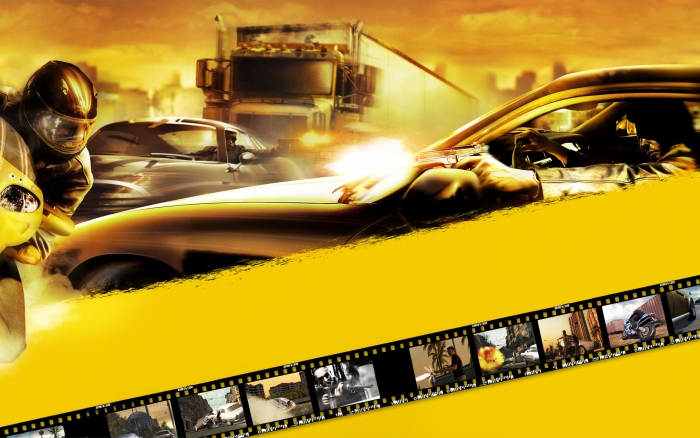
The most important thing to remember when looking at Driver
3 is that it is absolutely not trying to be Grand Theft Auto, The Getaway, True
Crime, or any such game. Driver 3 is about power sliding, traffic
swerving, high speed escapes through a Hollywood film
sized city. And it can be pretty polarizing.
Jumping right into Driv3r, it's easy to get lost as to what
you're meant to gleam from the game. There's a “take a ride” mode, which lets
you freely drive around the city, a story mode, and several small driving
minigames. Anyone who bought into the game on the assumption that it was a
GTA-wannabe probably felt disappointed by any of the options, regardless.
Starting with “Take a Ride” is what's recommended, because
it lets you get a good feel for the controls and individual handling of the
cars. And that's when I learned that something -no matter what anyone else may
say about it- that Driv3r can always claim, is that it has damn good driving
mechanics. Every emergency brake, slide, swerve, reverse, throttle, and jump
feels absolutely beautiful. Adding to the wow factor is an absolutely MASSIVE
selection of cars, all with varied handling, and amazingly detailed damage
models, at least for the time. There's nothing that feels quite as good as
weaving through traffic in a crowded city with cops on your tail.
 |
| You'll end up at Take a Ride one way or the other. |
Unfortunately, Take a Ride mode is also where the game takes
time to introduce you to its flaws. The cities are an absolute obstacle course
to navigate. Everything from trees to bushes to light-posts is indestructible,
and smashing into them is sure to halt your high-speed chase to a
teeth-grinding stop. I understand that one can argue large poles would
withstand being rammed, but I doubt too many people could agree that knee
high shrubs should be made of adamantium.
The reason these items are solid is to give the player some way to escape from the cops in less than speedy vehicles, and truthfully,
when you are able to dodge every pole in your path and leave the cops behind
you in a big wreck, it feels pretty good. It's not anywhere near comparable to
the oh-so brief feelings of flying through Miami
Other than taking a joy-ride and getting a grasp of the
mechanics, as its name implies, there's not really too much Take a Ride mode
has to offer. There are goons scattered throughout the three cities for
shooting, which unlocks extra challenges, but they're only bound to entertain
for ten or so minutes.
 |
| There's ten of these guys to take down in each stage. |
The main game (Undercover mode) is decently long, but it's not until the later
half of the first city -Miami-
No matter how forgiving and open you are to games, the first
time you try moving around and shooting with Tanner, you are going to be appalled.
There is absolutely no reason for the controls to work the way they do. Tanner's
legs move entirely separately from the rest of his body on the left stick, and
his torso, controlled with the right stick, moves far too slowly for you to get
a good aim on whatever it is you're trying to shoot.
The first mission is an exercise in frustration. You have to
confront a group of enemies after a brief drive, and you're more than likely to
just stand in front of them and smash the shoot button, which is what they'll
be doing too. It looks horrible, and it feels horrible.
 |
| Pew pew. |
The first shootout in the game gives you the absolute worst possible impression of the main mode. Even after you shoot through a few baddies, the rest of the stage is a very ho-hum chase after a criminal. Most people would probably put the game down for good at this point.
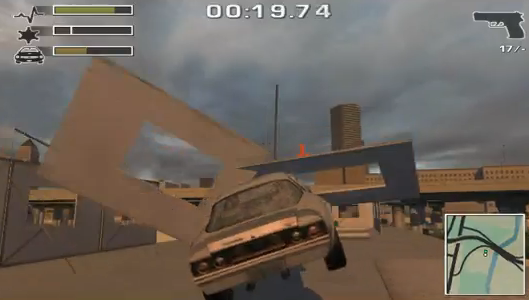
If you have the patience to get to stage five, the game
suddenly decides it wants to live up to its namesake, and you'll drive around a
lot, smashing through walls, jumping over buildings, and sliding through alleys.
 |
| Hello there fun. Where've you been? |
If you continue further into the game still, past another hideous on-foot section, you make it to the definitive "this is a Driver game" stage, where you escape through a mall flooding with cops, burst out the exit, and drive all the way back to your base with the police on your tail.
There's even a mission halfway through the second city in which the car will explode if you drop below 50 MPH, Speed style, and there's never a dull moment after that. Even the shooting sections become tolerable when you remind yourself what the reward is.
From then on, Undercover mode has its faults, but they pale in comparison to the thrills. There really aren't any other driving games out there like the Driver series, and Driv3r makes sure you have its name etched into your brain by the climax.
For all its faults, the game is ultimately a thrill to play, and it boasts some nearly flawless handling and diversity for its roster of cars and missions. Far from perfect, and far from great, it still certainly has enough of that delicious uniqueness only Reflections can offer, given you feel like digging for it.
Subscribe to:
Posts (Atom)